Special Article: The UGC's Equity Committees: Fracturing the Campus Unity Hindutva Seeks
The recent regulation released by the UGC represent a flawed mechanism to foster social justice and equality in the University Campuses


Co-authored by Advocate Anurag Chauhan
BA LLB Hons (CNLU), LLM in Constitutional Law, CNLU and Dinesh Singh, an IIT Delhi alumnus, entrepreneur, and former research affiliate at the Indian Institute of Science (IISc), Bangalore.
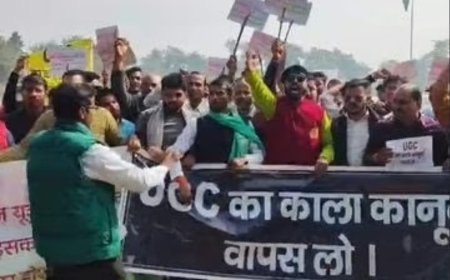
The recent regulation released by the UGC represent a flawed mechanism to foster social justice and equality in the University Campuses. On January 13, 2026, UGC released Promotion of Equity in Higher Education Institutions Regulations, 2026 which mandates Equity Committees to investigate the complaints of discrimination filed by Other Backward Classes (OBC), Scheduled Castes (SC), Scheduled Tribes (ST), women and persons with disabilities. As per the regulations, General Category students are excluded from filing complaints based on discrimination only the above-mentioned student categories can file complaint. The regulations aim to curb bias in higher education but its design lacks balanced safeguards and therefore could create rift among students and turn university campus into an arena of caste-wars. The regulations have been made on the directions passed by the Supreme Court in a Public Interest Litigation filed on behalf of Rohith Vemula's mother by Indira Jaising. The Supreme Court alarmed by the suicides based on caste discrimination directed the UGC to establish mechanisms for SC/ST students. The Hon’ble Court further held that grievance committees should have at least 50% representation from these communities for addressing their specific vulnerabilities. The Hon’ble clearly mentioned only SC/ST communities in its judgement in light of the constitutional protections provided under Article 15 and 17 of the Indian Constitution. It nowhere mentioned about OBC communities. However, in the final 2026 regulations, OBCs were included within the scope of caste-based discrimination which was therefore it was an expansion of victims beyond the original directive of Hon’ble Court. Thus, the ambit of caste-based discrimination does not cover only General Category as well as EWS. Further, the 2026 Regulations does not carry any provision which mentions that malicious or false complaints will be penalised.
- Equity Without Balance: Anomalies in the UGC Regulations, 2026
The UGC Promotion of Equity Regulations, 2026 mark a sharp departure from the earlier 2012 framework. While the objective of addressing discrimination and student distress is legitimate, several design choices risk weakening both equity and procedural fairness within higher education institutions.The most significant deviation is the shift from targeted protection to broad categorical coverage. The 2012 regulations were primarily focused on Scheduled Castes and Scheduled Tribes, consistent with constitutional history and institutional mechanisms such as SC and ST Cells. This ensured focused attention on communities facing the most severe and historically entrenched forms of exclusion. In effect, explicit protection applied to roughly a quarter of the population. The 2026 regulations expand protection to Scheduled Castes, Scheduled Tribes, and Other Backward Classes, extending the shield to nearly three fourths of the population.This expansion has the unintended effect of diluting the focused protection originally envisioned for SC and ST communities. By moving from a targeted framework to near universal coverage, distinct historical vulnerabilities risk being subsumed within a broader and less differentiated equity architecture. Further, the new framework introduces a serious procedural imbalance. While the regulations do not explicitly reverse the legal burden of proof, their structure effectively places the onus of justification on respondents outside the protected categories, predominantly General category students and faculty. Unlike the 2012 framework, which was conduct based and evidence led, the 2026 regulations do not codify evidentiary standards, inquiry thresholds, or due process safeguards.The absence of penalties for proven false or malicious complaints, combined with low or undefined evidentiary requirements, creates scope for misuse and weakens confidence in grievance redressal mechanisms.
Equity must rest not only on intent but on procedure. By expanding categorical coverage without parallel investment in evidentiary rigor and procedural safeguards, the 2026 regulations depart from the balanced approach of 2012, risking both fairness and institutional legitimacy.
The 2026 UGC equity framework carries a serious risk of unintended politicisation of campus governance. By privileging categorical identity over evidence, merit, and clearly defined procedure, it shifts dispute resolution away from academic norms toward ideological mobilisation. Such institutional designs are vulnerable to capture by organised political actors, including left leaning student and faculty groups and fringe formations often described in public discourse as “tukde tukde” groups. Routine academic disagreements may thus be reclassified as identity-based conflicts, deepening caste-based polarisation within Hindu society and weakening the constitutional principle of fraternity on campuses.
From a policy perspective, the more damaging consequence lies in governance failure. The absence of codified evidentiary standards, procedural safeguards, and deterrents against misuse encourages risk aversion, self-censorship, and compliance driven behaviour among faculty and students. Academic decision making becomes defensive rather than excellence oriented. This erodes institutional autonomy and undermines performance incentives that are central to high quality research and teaching.
At a time when global competitors are rapidly strengthening universities as engines of innovation in artificial intelligence, defence technologies, semiconductors, and advanced manufacturing, Indian universities risk being diverted into internal contestation rather than knowledge creation. Such an environment accelerates brain drain, as high performing students and researchers seek predictable, merit based academic systems abroad. The cumulative outcome is not merely administrative strain, but a measurable decline in academic productivity and global competitiveness, with direct implications for India’s technological and strategic ambitions.
Further there are certain insecurities and apprehensions raised by the stakeholders, the General caste people, on the current procedure of complaints mentioned in the provisions. For instance by clubbing OBCs as victims alongside SCs and STs can SCs or STs file a complaint against OBCs? Since a lot of SC-ST cases are filed against OBCs too which reflects that OBCs are too perpetrators of anti-SC/ST crimes. The provisions are silent on this. Also, a huge section/percentage of Muslims come under the ambit of OBCs so, by putting OBCs in into the list of victims will this not disrupt the religious harmony in cases of fake complaints or in cases where someone fuels conflicts for political or personal benefit to disrupt communal harmony. Therefore, these loopholes or the silence of explicit provisions haunts us with the horrors of British passed legislations like that of 1919 Act/Separate electorates for “divide and rule policy”. Therefore, such provisions if not being made or clarified properly safeguarding the interests of every section of the society including the General Category could fuel civil war like conditions in a long run sponsored controversies or rifts by Breaking India Forces as mentioned by Snakes in the Ganges Book by Rajiv Malhotra.
- Student Suicides in Higher Education: What the Data Shows
Public debate and court proceedings on student suicides in India’s higher education institutions often focus on a few prominent cases, frequently framed through a narrow caste lens. While every such death is a tragedy and discrimination must be addressed, available data from centrally funded institutions tells a more complex story.Between 2014 and 2021, suicide data across higher education institutions shows that suicides do not follow a linear caste pattern. In the IITs, around 47 percent of student suicides were from the General category, OBC students accounted for about 25 percent, SC students 23 percent, ST students 3 percent, and minorities around 2 percent.The trend is even sharper in the IIMs, where nearly 80 percent of student suicides were from the General category, followed by OBC at 10 percent, SC at 7 percent, ST at 2 percent, and minorities at 1 percent. Across all centrally funded higher education institutions, General category students accounted for about 42 percent of suicides, followed by OBC at 34 percent, SC at 20 percent, ST at 2 to 3 percent, and minorities at 2 to 3 percent.These figures do not negate caste-based disadvantage. They do, however, challenge the assumption that student suicides in elite institutions are primarily caste driven. Instead, they point to a systemic crisis shaped by extreme academic pressure, fear of failure, isolation, financial stress, and weak institutional support.The data suggests a clear need for broad, evidence-based reforms in mental health support and institutional culture, because this is a failure of the system, not of any one social group.
- Conclusion and Suggestions
Therefore, the Regulations should not be implemented without clear procedural safeguards, defined evidentiary standards, and fairness of process. In the absence of such guardrails, there is a real risk of false or malicious complaints being used as political instruments rather than tools for genuine equity.Significantly, on 29 January, the Supreme Court stayed the implementation of the UGC Promotion of Equity Regulations, 2026, noting that certain provisions are vague and capable of misuse, particularly the separate definition of “caste based discrimination” despite the existence of a general definition of discrimination. This raises serious concerns regarding clarity, proportionality, and constitutional consistency.At a time when global universities are racing ahead in artificial intelligence, quantum technologies, defence research, and advanced innovation, regulatory frameworks that weaken academic freedom and institutional stability risk undermining India’s ambition to become a global centre of research and innovation.Equity must reinforce excellence, not erode it.
What's Your Reaction?