Special Article: A Glimpse of Kshatriyas (Rajputs) of Aligarh and Hathras districts of Uttar Pradesh
After the occupation of Bhárata by Hunas, Shakas, Kushans etc., the Vedic Kshatriyas (Solar and Lunar race) retained their identity....
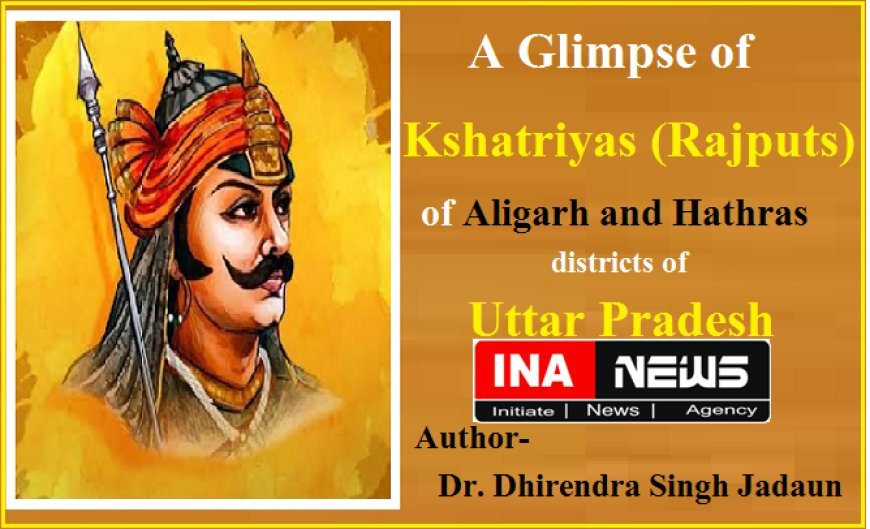


A Glimpse of Kshatriyas (Rajputs) of Aligarh and Hathras districts of Uttar Pradesh
After the occupation of Bhárata by Hunas, Shakas, Kushans etc., the Vedic Kshatriyas (Solar and Lunar race) retained their identity with the word Rajaputra (Rajput) because these foreign invaders started calling themselves Kshatriyas by merging in the main stream of our country. When these Rajaputras got an opportunity to grab power, they did not miss it and occupied the power under the nomenclature 'Rajput'; this is how they were commonly addressed by the masses.
Amongst the Rajputs the following clans are the most important in Aligarh and Hathras district :-
Jádon, Chauhán, Pundír, dors, Janghára, Bargújar, Gahlot, Bhále Sultan, Bais, Panwár, Gaharwár, Rathod, Tomar, Jaiswár, Bangar, Chhonkar, Kachhwáha, Porach, and Solankis. The remainder are unspecified.
- The Dors /Dund -
The Dors give a curious account of the derivation of their tribal e. They state that one of their kings offered his head to some local Traditional origin. goddess, and was thus called Dund, which was afterwards corrupted into Dor. They claim kinship with the Ponwars, and their name is certainly found in the genealogical tables of that tribe. Dors are old settlers in the district, and were contemporaries of the Dors and Meos before the Musalman conquest.
The Dors are supposed to have emigrated from the middle to the upper Doáb, early in the 10th century. They appear to have held a large tract of country between the Jumna and the Ganges, long anterior to the Muhammadan invasions. Hardatta, a Dor chieftain, who founded Meerut and built Hapur, preserved possession of his family domain at Baran by becoming a convert to Islám, and paying a large ransom to Mahmud of Ghazni. About the beginning of the 12th century, the power of the Dors began to wane. They were attacked by Méos and Játs, who at last became such a source of trouble to the Dor Rája, that he was glad to call in others to aid him in restoring order.
A large band of Bargújars were on their way from Alwar to aid Pirthiraj in his war with the Mahoba Chandels. To Rája Partap Singh, the leader of the party, was entrusted the duty of subduing the Méos, and after a long and determined struggle he succeeded in driving them out. As a reward the Dor Rája gave him his daughter in marriage, with a dowry of 150 villages. The Bargújars remained nominal feudatories of the Dors until 1193, when the latter were again attacked by the Musal máns under Kutub-ud-din Aibeg, who captured Meerut and Baran.
Chandra Sén who was the Dor Rája at this time, repelled the attacks of the enemy with great vigour, until betrayed by his kinsman Ajaipál, and a confiden-tial Brahman retainer. Chandra Sén perished in the assault of his fort, but not before he had killed with an arrow Khwaja Lál Ali, the leader of the Muhammadan troops. The power of the Dors rapidly declined after this, and the clan has now but little influence.
In Uttar pradesh , they are chiefly settled in the Meerut, Aligarh, Bulandshahr, Moradabad and Banda districts.
- The Jadons -
Jadons are descendants of Lord Shri Krishna of pure ancient Yadava race and through him from Yadu of Lunar race. Their home native place is Bayana in Bharatpur district after migration from Mathura in 1018 A.D.Those living in these districts appear to have come from Jalesar in Etah district and Mahaban in Mathura district but they have long been established here ,and own land in all parts of both the districts. Jadons found in the district everywhere , but are far stronger in tahsil Koil , block Dhanipur ,Lodha and in Sikandra Rao tahsil block Akrabad .They are also found Khair, Iglas ,Hatharas ,Atrauli tahsils in small numbers.
Some of them (jadons ) are described as Chhonkars , Jaiswars and Porach of Hatharas tahsil are said to represent a branch of the Jadon clan. Chhonkars are found in small numbers in Atrauli tahsil.Porach are found in large numbers in Hathras and Sikandra Rao tahsils .
The Bhattis or Jaiswárs also call themselves a branch of the Jadon stock. They came from Jaisalmír, and many of them have become Musalmans in this and the neighbouring districts. They say, as usual, that they came here in the time of Prithiraj Chauhan ruler of Delhi.
- The Chauhans-
Chauhans are scattered all over the districts , but are the strongest in Khair,Sikandra Rao and Aligarh and in former days held almost the whole of the Khair, Chandaus, and Morthal areas . They trace their descentfrom the ancient rulers of Delhi ,the ancestors of Khair Chauhans being Rana Sangat, whose great-grandfather of Cháhara Deva, the brother of Prithiraj Chauhan of Delhi , one of whose numerous progeny settled in Khair. Some Chauhans especially in Sikandra Rao tahsil are descendants of Etah and Mainpuri Chauhan.Bhupal Singh of Khair was a great freedom fighter of 1857 of this clan.
- The Pundirs -
A sept of Rajputs who appear to belong to the Dahima, one of the thirty-six royal tribes, of whom Colonel Tod writes: "The Dahîma has left but the wreck of a great name.Seven centuries have swept away all recollection of a tribe who once afforded one of the proudest themes for the song of the bard.
The Dahima was the lord of Bayâna and one of the most powerful vassals of the Chauhan Emperor, Prithivi Râja. Three brothers of this house held the highest offices under this monarch, and the period during which the elder, Kaunas, was his minister, was the brightest in the history of the Chauhân. But he fell a victim to blind jealousy. Pundir, the second brother, commanded the frontier at Lahore. The third, Châond Râê, was the principal leader in the last battle, where Prithivi Râja fell, with the whole of his chivalry,on the banks of the Kågar. Even the historians of Shahâb-ud-dîn have preserved the name of the gallant Dahîma, Châond Râê, whom they style Khande Râê; and to whose valour, they relate, Shahâb-ud-dîn himself nearly fell a sacrifice. With the Chauhân, the race seems to have been extinguished." The original seat of the Panjab Pundirs was Thanesar and the Kurukshetra of Karnal and Ambala,with local capitals at Pûndri, Ramba, Habri and Pûndrak; but they were dispossessed by the Chauhân under Rana Har Râê, and for the most part fled beyond the Jumna. From this event most probably their settlement in these Provinces dates. In the Duâb they say that they came from Hardwår in the Saharanpur District.
Their leader is said to have been Raja Damar Sinh, who established himself at Gambhira in Pargana Akrâbâd of the Aligarh District. Their fort was Bijaygarh, which took its name from Bijay, brother of Damar Sinh. It was captured in 1803 at the cost of the lives of Colonel Gordon and other British officers. It has now passed into the hands of the Raja of Awa. These Duâb Pundirs hold a respectable rank and intermarry with the higher Rajput septs.
They also called Purirs, form an important clan, and in these districts are more prosperous than any other of the old Rajpút clans. The Pundirs are found chiefly in the Sikandra Rao and Koil tahsils ,and in the former they hold large estates , their chief families being those of Sahaoli ,Akrabad ,Nai and Thakur Mahtab Singh and Mangal Singh were the great freedom fighters of Akrabad of this pundir clan in 1857 mutiny .
- The Tomars and Jangharas -
Tomars in Hathras ,Iglas and elsewhere ,the total including the Jangharas ,who in early days held most of the Iglas tahsil and claim descent from the Tomars of Delhi. They give the derivation of their name as jang (war) and áhára (hungry), or those who hunger after war; but their enemies say that they might as well derive the name from 'jang' and 'hára' (worsted), those who were overcome in war.
- The Bargújars / Raghaves -
According to Tod the Badgujars are the descendants of Love ,the elder son of Rama ,and were expelled from their ancient settlements in Rajawar or Rajor in Macheri of the Jaipur State by the Kachhawahas. The Barauli family of Badgujar in Aligarh district trace their origin to Raja Rajdeo of the solar race ,whose father erected the fort of Rajor in the Macheri country .The great -grand son of Rajdeo was married a sister of Prithiraj Chauhan ruler of Delhi ,and in the time of their son Pratap Singh the Bargujars first left Rajor.The family story is that Pratap Singh was sent by Prithvi Raj with an army to Kumaun.
The Aligarh legend makes Pratap Singh the leader of an army against Kumaun hills in the 12th century A,D , not Mahoba। According to the MB ,the villages of Gaonri ,Tamkoli ,Pratappur ,Potha and Malikpurah of pargana Barauli were granted to Rao Pratap Singh by Prithiraj Chauhan of Delhi as a reward for his successful campaign in Kumaun hills .His camp was pitched amongst a cluster of Meo village ,and was plundered by the people of the neighbourhood .In revenge for this , he attacked the Meos and defeated them , and as reward received 175 villages as dowry with the daughter of the Dor rajput Chieftain Chait Singh of Koil.On his return from Kumaun , the Raja settled in Barauli and made Barauli his capital and increased his possessions to the numbers of 1656 villages.
The Barauli Badgujars call themselves the elder branch ,and say that the title of "Rao" now borne by them was conferred on their ancestors by Prithiraj himself , as an honorific appellation to be borne by the eldest branch alone .They claim descent from Ranu ,the eldest son of Pratap Singh , and say that the Lalkhani Badgujars of Katehir are descended from Jatu .From Basant Pal ,another.son ,come to Badgujars of Majhola in the Badaun district ;those of Jadwar area are descended from Badhon Deo ,a forth son ,and the Badgujars of Narauli in the Moradabad district are descendants of Hathi Sah ,a fifth son of Pratap Singh. The Badgujar appear to have held the entire Jawan block in Barauli area and in the northern part of the tahsil Atrauli in 16th century
- The Gahlots -
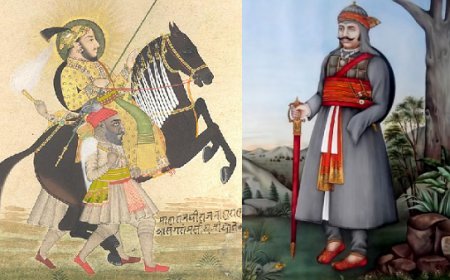
The gahlots are one of the thirty-six royal tribes, and formerly held large possessions in both the districts . This clan is divided into two great branches, the Sisodhiya and Ahariya. The branch in both districts is the Sisodhiya, which is the same as that to which the Rána of Udaipur or Mewár, the premier Raja of Rajputána and the "sun of the Hindus," belongs. Tod¹ devotes a large portion of his first volume to the annals of the Gahlots of Mewár. The Gahlots are of the Solar race, and trace their descent from Lava, the eldest son of the deified hero Ráma. They emigrated from Oudh and settled at Dwárka in Gujrát, and on their expulsion from thence settled in Mewar and changed their name to Gahlot. One branch made the town of Ar or Ahár, in the valley of the present capital of Udaipur, their chief seat, and were hence called Aháriyas, whilst another branch settled in Sisodha on their expulsion from Chitor, and founded the present house of Mewár.
Also Read- Special Article- मुफ्त की योजनाओं के प्रति आर्थिक चिंता.... ?
The origin of the name Gahlot is said to be in this wise: on the expulsion of the clan from Gujrat, the queen Pushpávati alone escaped the sack of the capital (Balabhi), where her husband, the celebrated Siláditya, was slain. This event happened in 523 A.D. The queen fled to a cave in the hills and was there delivered of a son, whom she named Guha or the cave-born. His descendant Bappa seized on Chitor in 727 A.D., and founded the Gahlot dynasty of Mewár, who subsequently removed to Udaipur .The Gahlot prince of Chitor married the sister of Prithiráj, and it is to this connection is due the presence of Gahlots in the Upper Duáb. They all say that they came to assist the Chauhan prince of Dehli in his numerous wars, and that in reward he gave them over the lands of the Meos and the Dors. Chand Bardai mentions Gobind Rao, Gahlot, as one of Prithiraj's auxiliaries. The Bulandshahr Gahlots say that they settled near Dásna under Raja Khumán at an early period. A long inscription in a math behind the temple of Achalesvara on mount Abu, bearing date 1286 AD., speaks in high praise of the liberal race of Guhila, so early to Gahlot.
One branch made the town of Ar or Ahár, in the valley of the pre-sent capital of Udaipur, their chief seat, and were hence called Ahariyas, whilst another branch settled in Sisodha on their expulsion from Chitor, and founded the present house of Mewár. The origin of the name Gahlot is said to be in this wise: on the expulsion of the clan from Gujrat, the queen Pushpávati alone escaped the sack of the capital (Balabhi), where her husband, the celebrated Siláditya, was slain. This event happened in 523 A.D.
The queen fled to a cave in the hills and was there delivered of a son, whom she named Guha or the cave-born. His descendant Bappa seized on Chitor in 727 A.D., and founded the Gahlot dynasty of Mewár, who subsequently removed to Udaipur. The Gahlot prince of Chitor married the sister of Prithiráj, and it is to this connection is due the presence of Gahlots in the Upper Duáb. They all say that they came to assist the Chauhan prince of Dehli in his numerous wars, and that in reward he gave them over the lands of the Meos and the Dors. Chand Bardai mentions Gobind Rao, Gahlot, as one of Prithiraj's auxiliaries.
The Bulandshahr Gahlots say that they settled near Dásna under Raja Khumán at an early period. A long inscription in a math behind the temple of Achalesvara on mount Abu, bearing date 1286 A.D., speaks in high praise of the liberal race of Guhila, so early had the name been fixed. But here Guhila is made the son of Vappaka, and it is said that the name Guhila "is attached to the princes who have been born in his race." Some say that the Guhila Rajpúts are distinot from the Gahlots, and this may be due to a branch formed by this Guhila, son of Bappu, the conqueror of Chitor. Gahlots are chiefly found in Hatharas district and Atrauli tahsil of Aligarh district.
- The Panwars -
They are found in small numbers in Hathras and Sikandra Rao tahsils .
- The Bhale Sultan / Solanki -
The Bhale Sultan of Bulandshahr are a debased branch of Solankis probably connected with the Raja of Bhal in Gujrat .Their ancestor,Sarang Deo ,took service under Prathviraj Chauhan ,and was killed in the attack on Kanouj .As reward ,his descendants received lands of Bulandshahar.
The Bhale Sultans of Khurja have claim both their descent and their title from Hamir Singh, the son of Sarang Deo, who received the title of Bhale Sultan from Shahab-ud-din. Seventh in descent from him came Kirát Singh, who, in the days of Ghias-ud-din Tughlaq, drove out the Meos and obtained possession of 84 villages in Khurja. He settled at the village of Arniyan, and divided the villages between himself and his cousins, who resided at Kakaur.
The Bhale Sultan of Sasni in Hathara are ,connected with the Khurja family in Bulandshahr , but their present possessions are very small.
Also Read- Special Article: कैसा रहा यूपी का बजट 2025-26? इस बजट में अन्य राज्य सरकारों के लिए क्या नसीहत?
- The Porach and Bangars -
They formerly possessed Daryápur, Háthras, Mendu, and Husain, but all have now passed out of their hands. They are old settlers in these districts, and were contemporaries of the Dors and Meos before the Musalman conquest.
The other clans including Kachhwahas of Koil ,Rathods and Gaurahars of Atrauli are also found in small numbers and having probably crossed the Ganges from Badaun district . None of the other Rajpút clans require any particular notice here. Altogether Rajpúts still possess near about 544 villages, with an area of 346,648 acres in both districts , in full proprietary right.
- References -
- Board's Records, 23rd May, 1809; No. 11: 16th June, 1809, No. 14: 4th July, 1809, No. 35: 11th July, 1809, No. 39: 29th September, 1809, No. 33: 17th November, 1802, No. 29. G. O., 5th January, 1816: Board's Records, 12th April, 1814, No. 8; 13th October, 1815, No. 1; 16th February, 1816, No. 2; 23rd February, 1816, No. 1; 21st December, 1821, No. 35.
- Aligarh :A gazetted of the district gazetteers of United Provinces of Agra &Qudh ,Bill .4 , by H.R.Nevill , 1909.
- Aligarh District :A Historical Survey ,Aligarh ,Chap.VII , p.173-189.by J.M.Siddiqi .
- Misl Bandobast , Vazibul-Arza , Mauza Tochhi , Pargana Aligarh ,1281 Hi .Fasal ,year 1873A.D.
- The Jat rulers of Upper Doab by Jagbir Singh.
- Statistical ,descriptive and historical account of the northwestern Provinces of India ,Meerut division pt.I ,1874. Allahabad ,Bill.II.
- J.Thorton , Report upon .The settlement of pergunnah Moordhany .Zillah Allyaarh ,Vide Allygurh ,Statics.pp.236 ,noted in Aligarh district.
- Baber 's Memoirs.
- Elliot History II .Appendix.
- Indian Journal of Archaeology , Voll 2 ,No .4 ,2017 . Archaeological Gazetteer of Aligarh and Hathras districts with special reference to OCP and other Proti-Historic cultures of Indo-Gangetic plains by Editor Chief Vijay Kumar.
- Smith W.H.settlement Report . 345 Aligarh district .Allahabad.
- Raja Lachhaman Singh Bulandshahr Memo .
- District . Census Handbook UP 6-Aligarh.
- Board's Records ,31st August , 1822,No 7.
- Uttar Pradesh district Gazetteers .Mathura , Govt of UP .1968 .
- Crooke William C.A.1886 .The Tribes and Castes of North-Western India.Voll.I to V.
- The Tribes and Castes of the Punjab and North -West Frontier section IV.by H.A.Rose.
- Glossary of the Tribes and Castes of Punjab and North-West .Vol 1.
- Sherring M.A.Hindu Tribes and Castes .Vol.I to III. Investing .Punjab Castes.
- S.H.M.Elliot .Supplemental Glossary of Terms used in N.W.P
- Hand book on Rajputs by Captain A.H.Bingley.
Author -Dr Dhirendra Singh Jadaun
Village -Larhota near Sasni
District -Hatharas ,UP.
Principal Govt Girls P.G.College , Sawaimadhopur , Rajasthan
What's Your Reaction?